When is flow matching the same as optimal transport?
Run a flow-matching ODE from one Gaussian to another. Run optimal transport between the same two Gaussians. The two maps coincide if and only if the covariances commute — and in that case the map is the simple Bures form, independent of the schedule you chose.
and in the commuting case \( \, T_1 = \big(\Sigma_1\Sigma_0^{-1}\big)^{1/2} \) — symmetric, equal to the Bures–Wasserstein map, the same for every valid schedule.
This proof's first version was wrong. The fleet's own adversary caught an invalid converse argument and a gap in dimension three and up. We kept the receipt of the fix — and then closed the hard direction for real, unconditionally. Anyone can show a green check; almost no one shows the red they passed through to get there.
The verdict, from the kernel — not from us
Below is the real output the Lean kernel and the audit produce. The
machine-checked commuting case carries only the three foundational
axioms — no sorry, no project-local axiom standing in for a
missing argument. Every number in the strip above is captured from a command
at build time; see §6 Reproduce / verify.
Source repository ↗
github.com/noogram-labs/flow-matching-gaussians — notebooks, paper
(.tex), the Lean project, and the report renderer. Clone it,
run it, check the proof yourself.
Mission context — where the question came from
This work began as an answer to a question someone else chose. At a seminar of the ENS Centre Sciences des Données (CSD), Gabriel Peyré posed a deliberately semi-random problem — when does a flow-matching (or diffusion) flow between two Gaussians coincide with optimal transport? — as a common prompt to compare several agentic coding approaches: hand the same open-ended question to autonomous coding agents and see what each one actually delivers.
This page is one such submission, produced end-to-end by an orchestrated agent fleet. Compared across the several agentic approaches, it sat at the high-rigour end of the explored performance-versus-cost Pareto front: it spends more to buy a machine-checked Lean proof and an adversarial audit, rather than stopping at a plausible-looking notebook. Everything below — the proof, the notebooks, the paper, and the fleet's own self-report — is the fleet's answer to that prompt, with each claim wired to the evidence that backs it.
The prompt, verbatim
The exact brief every approach received — Gabriel Peyré's todo.md,
reproduced unedited (original wording and spelling preserved):
Consider flow matching with a stochastic interpolant a(t)*X0+b(t)*X1 for t in [0,1]. The advection velocity field is a conditional expectation.
In python/ do an indepth numerical simulation in a nice jupyter notebook in pytorch when X0~N(0,Id) and X1 is a mixture of three diract. The density of Xt is closed form and use pytorch to compute the velocity. Shows sample trajectories, the 3 dirac have 3 colors and display the trajectory with the color of the closest point they converge to. Contrast 3 different usual choice of a(t) and b(t) (linear, variance preserving, cosine). Contrast these trajectory with the optimal transport trajectories. Make the notebook very pedagocial with nicely written maths derivation in text cells between the plots.
In paper/ write a detailed latex article about this, with abstract, intro with litterature, then general presentation the setup. Then add an XP section with the 3 dirac case where you explain it and integrate nicely the figures generated by the above mentionned notebook. Then another section with the gaussian case X0~N(0,Sigma0) X1~N(0,Sigma1), where you will compute in closed form the Sigma_t and the flow map T_t as a function of a(t) and b(t). Contrast the formula for T_1 with the OT map between the Gaussian, and study when it is the case that they are equal. Write a polished theorem with a clean proof. Add nice numerical display of the covariance evolving depicted as ellpises (you need to add a new jupyter notebook to do these plots and export the figs as PDF).
Structure this repository in a professional fashion, with a detailed readme and all that is to be expected for a professional code base with a latex article.
— the original challenge file, as handed to the participating agents.
§1 · The result
For the independent-coupling Gaussian interpolant \( X_t = a(t)X_0 + b(t)X_1 \), the marginal covariance is \( \Sigma_t = a(t)^2\Sigma_0 + b(t)^2\Sigma_1 \), the advection velocity is linear, \( v(x,t)=A_t x \) with \( A_t = \tfrac12\dot\Sigma_t\Sigma_t^{-1} \), and the flow map \( \Phi_t \) it generates pushes \( \mathcal N(0,\Sigma_0) \) to \( \mathcal N(0,\Sigma_t) \). Call its terminal value \( T_1 \). The Bures–Wasserstein optimal-transport map between the same Gaussians is \( T_{\mathrm{OT}}=\Sigma_0^{-1/2}\!\big(\Sigma_0^{1/2}\Sigma_1\Sigma_0^{1/2}\big)^{1/2}\Sigma_0^{-1/2} \).
The dichotomy. \( T_1 = T_{\mathrm{OT}} \) exactly when \( \Sigma_0 \) and \( \Sigma_1 \) commute. In the commuting case the flow map collapses to the schedule-independent Bures form \( T_1=(\Sigma_1\Sigma_0^{-1})^{1/2} \), which is symmetric. When the covariances do not commute, \( T_1 \) is non-symmetric and differs from the (always symmetric) OT map.
The honest boundary, up front
- Machine-checked in Lean: the forward, commuting direction —
symmetry of \( T_1 \), the Bures pushforward identity, and \( T_1 = T_{\mathrm{OT}} \).
lake buildexits 0;#print axiomsshows only the three foundational axioms. - Informal in Lean, mathematically complete: three companion results (R1 the matrix-ODE ↔ algebraic-map bridge, R2 schedule-independence, R3 the \( d\ge 3 \) converse) live in the paper under the axiom firebreak discipline — honest informal arguments rather than faked Lean terms, because the Mathlib infrastructure they need (time-ordered exponentials, path-ordered holonomy) does not yet exist.
- R3 is closed — unconditionally, in every dimension. What looked like the hard direction turned out to hinge on a hidden closed form: on the straight-line schedule the flow's drift matrices commute, time-ordering collapses, and \( T_1=(\Sigma_1\Sigma_0^{-1})^{1/2} \) is algebraic. Symmetry of \( T_1 \) then forces \( \Sigma_1\Sigma_0^{-1} \) symmetric — exactly commutation. No dimension restriction, no conditioning hypothesis, no residual gap. The fleet caught its own gap here and then closed it.
§2 · Notebooks
Two pedagogical PyTorch notebooks, executed end-to-end and rendered to
self-contained HTML. The source .ipynb files live in the
repo's python/.
A — three-Dirac mixture →
The marginal stays a closed-form Gaussian mixture at every instant. Trajectories coloured by which atom they fall into, three schedules contrasted, flow-matching paths set against semi-discrete optimal transport.
B — covariance ellipses →
The Gaussian-to-Gaussian case: \( \Sigma_t = a^2\Sigma_0 + b^2\Sigma_1 \) drawn as evolving ellipses, commuting vs non-commuting schedules, and the commutator sweep behind the converse.
§3 · The paper
The full write-up — setup, the three-Dirac experiment, the Gaussian section
with the theorem and its proof, and the numerical evidence.
Download the PDF · the LaTeX source
(paper-v1.tex
+ references.bib)
is in the repo.
§4 · The proof — the credibility anchor
The Lean source, not a screenshot. The fidelity anchor is the theorem
FMG.flowMap_isHermitian_pushforward_eq_otMap_of_commute, proved
basis-free through the continuous functional calculus (so the repeated-eigenvalue
cases that sink the naive diagonalisation never arise).
FMG/Gaussian.lean →
The anchor theorem and its lemmas, syntax-highlighted. flowMap σ₀ σ₁
is Hermitian, solves the Bures pushforward equation, and equals the OT map.
The firebreak ledger
The disclosed gaps, each a clearly-scoped infrastructure or out-of-scope item —
never the main theorem, never an axiom smuggled into the library.
Full detail in lean/unproved.md.
| Residual | What it is | Status |
|---|---|---|
| R1 | Matrix-ODE \( \Phi_1 = \) flowMap bridge (needs time-ordered-exponential machinery Mathlib lacks) | informal — infrastructure gap |
| R2 | Schedule-independence / flatness (rides on R1; structurally already true of the Lean object) | informal — out of Lean scope |
| R3 | The \( d\ge 3 \) converse \( T_1 \) symmetric \( \Rightarrow [\Sigma_0,\Sigma_1]=0 \) | closed unconditionally — informal in Lean, math complete |
The adversary that rejects axiom-smuggling
A green build does not certify a faithful proof if the context is
poisoned. The corpus's ninth entry,
A9_AxiomSmuggling.lean,
builds clean by smuggling a false universal in as an axiom and
feeding it to the verified theorem — and is caught not by the exit code but by
the #print axioms audit. Author ≠ scorer: the red team writes the
variants, the checker grades exit codes against the manifest.
| Gate | Verdict | Evidence (build-time) |
|---|---|---|
lake build | exit 0 | anchor accepted; shipped source blob-matches kernel-provenance.log (760ec9b…) |
| 0-sorry | clean | grep -rn sorry over the paper theorem files → no match |
| no project axiom | clean | only propext, Classical.choice, Quot.sound |
| adversarial corpus | 9 / 9 | 8 rejected + 1 axiom-smuggling build flagged by the audit |
§5 · The fleet that watched itself work
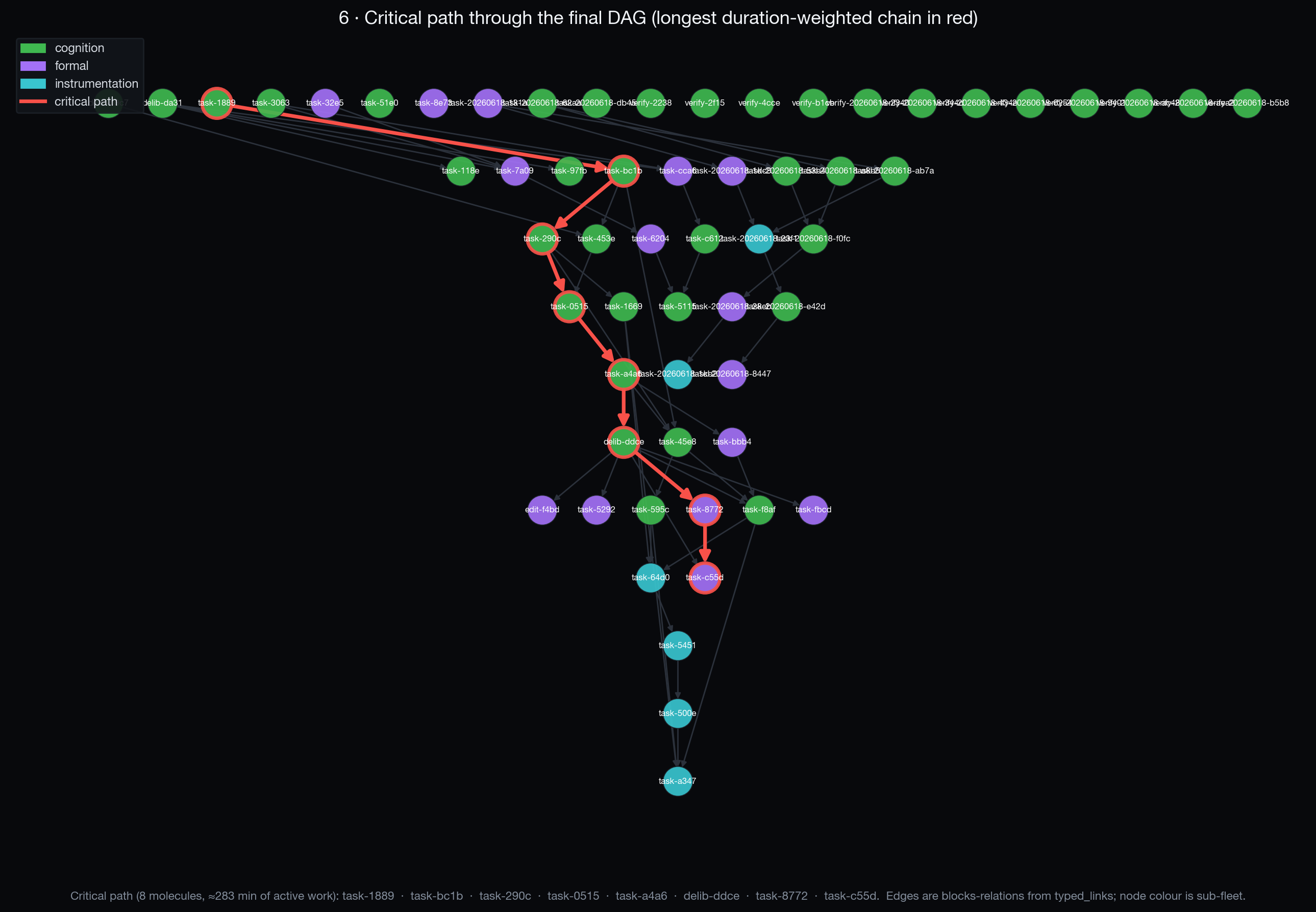
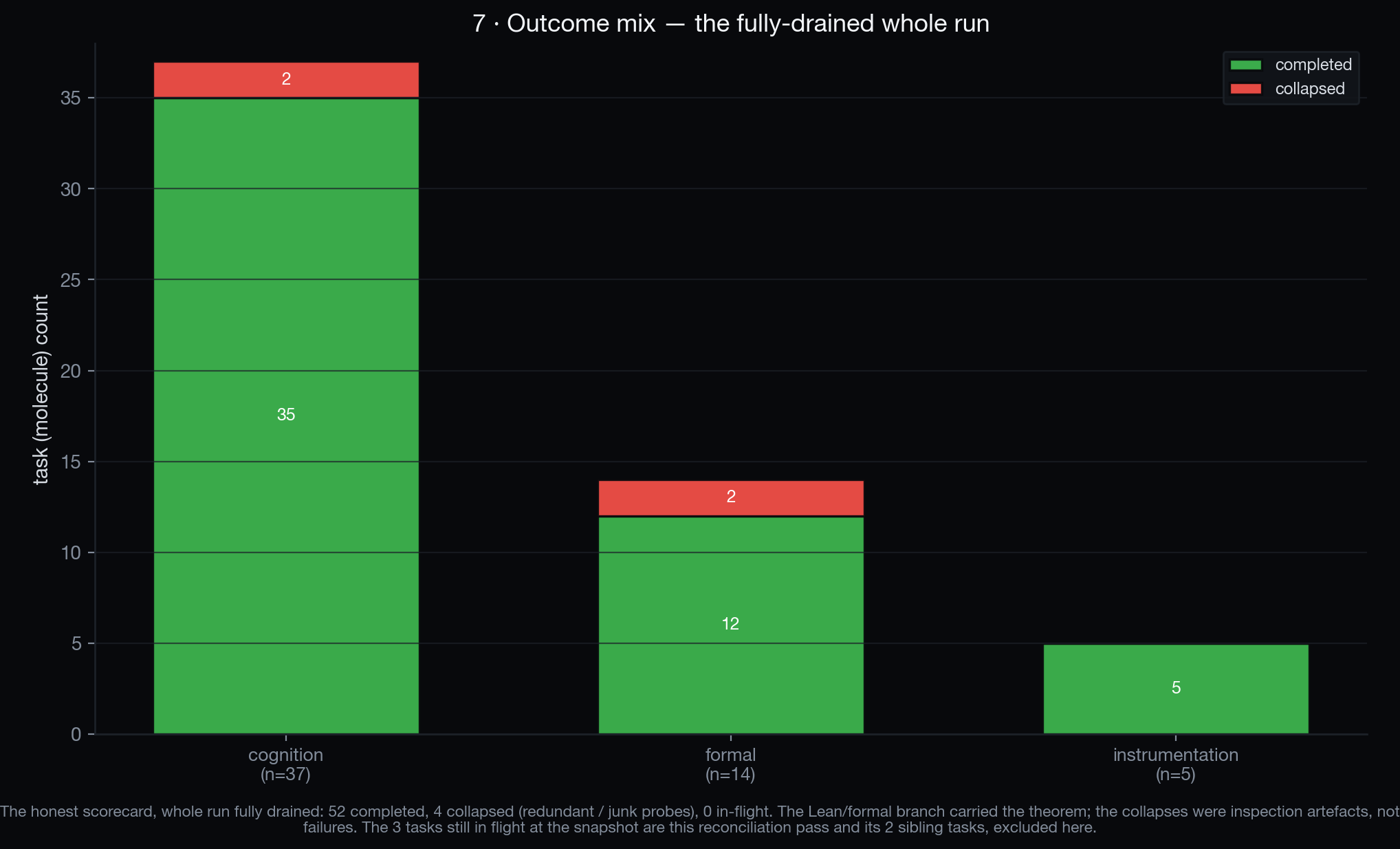
Strip away the science and here is the meta-story: a swarm of software agents was given one question and told to deliver a publishable result — and it kept a logbook of its own motion while it worked. The arc is a soap bubble: polymerisation (the opening plan fans out), foaming (children get nucleated mid-flight, the froth swells), drainage (the foam settles, green fills the frame). Every number is pulled from a real field in the fleet's event log; where a number under-counts, the chart says so out loud — and we leave the caveat on.
Two of those views are now interactive and in this page's
own charter — hover any role or any bar for detail, or open the full
living-document page: the fleet, up close ↗. They are
generated straight from the real .cosmon/state/events.jsonl +
runtime-trace.jsonl by report/fleet_viz.py.
The same arc, told once more in seven static charts — each with its caveat left on:
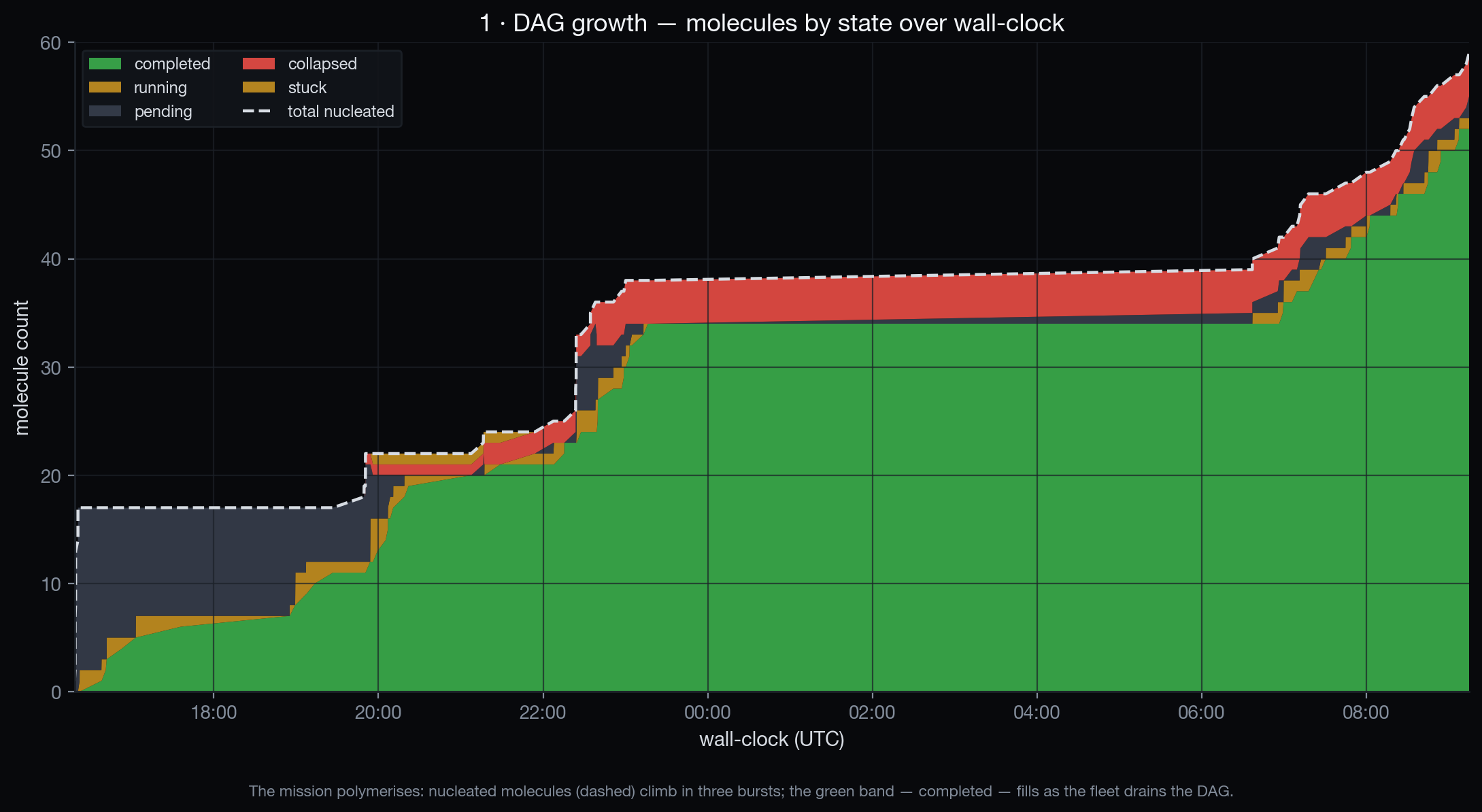
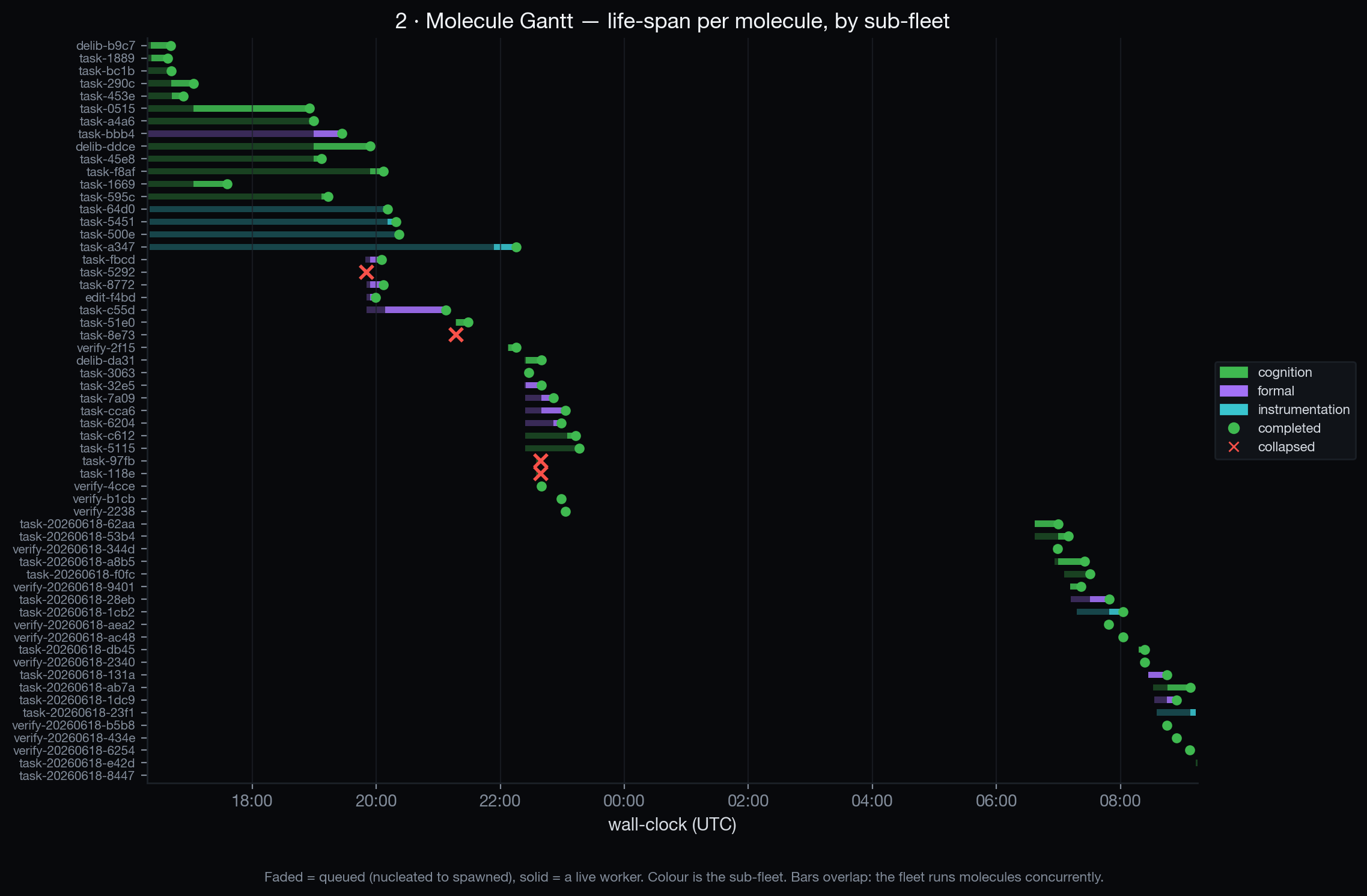
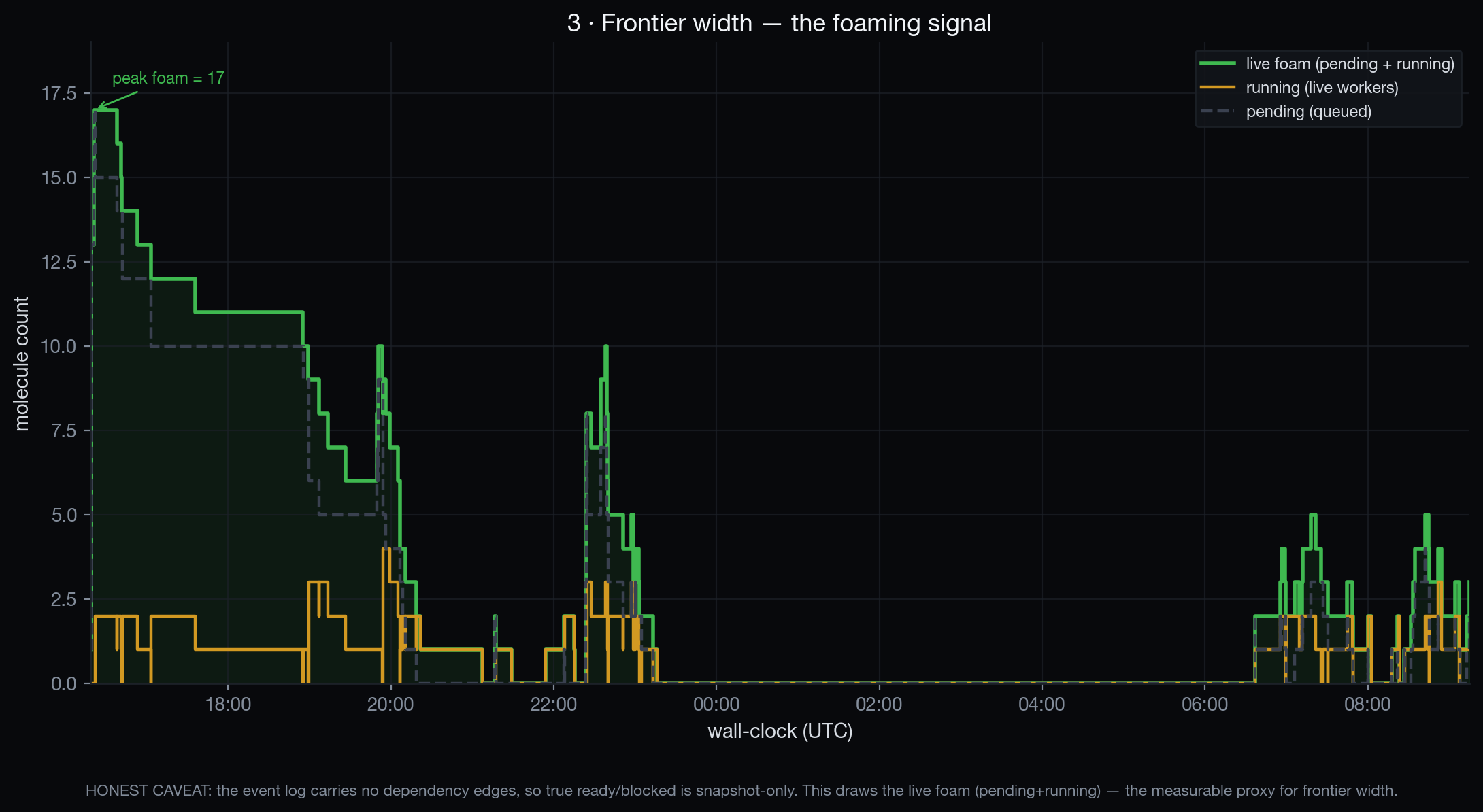
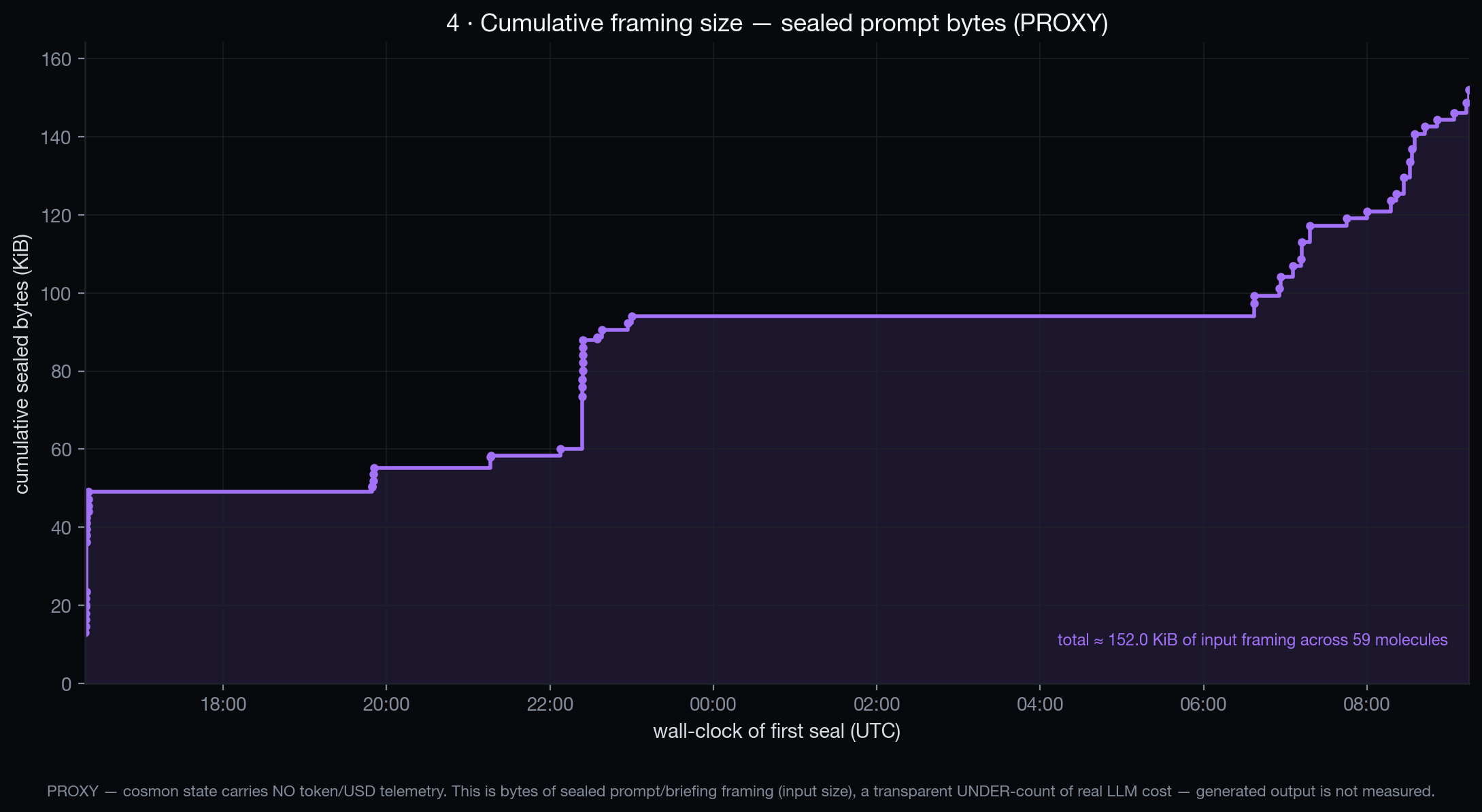
claude-opus-4-8), summed from
the per-message usage blocks in the session transcripts and priced
at Anthropic's published rates: $19.63 input + $139.44 output + $259.69
cache-read + $177.67 cache-write (5-min + 1-hour tiers). The curve above is the
bytes proxy from costs.csv; the dollars come from the
transcripts.
Three audit trails, named honestly: cs ensemble
prints live per-worker INPUT/OUTPUT/COST, events.jsonl +
runtime-trace.jsonl log every transition, and costs.csv
is a sealed-bytes proxy — the transcripts are the real-token source of truth.
94.8% of token volume is cache reads; caching turned a ≈ $2,597 input bill into
$260 (≈ $2,337 saved). This snapshot necessarily excludes this reconciliation
run's own tokens.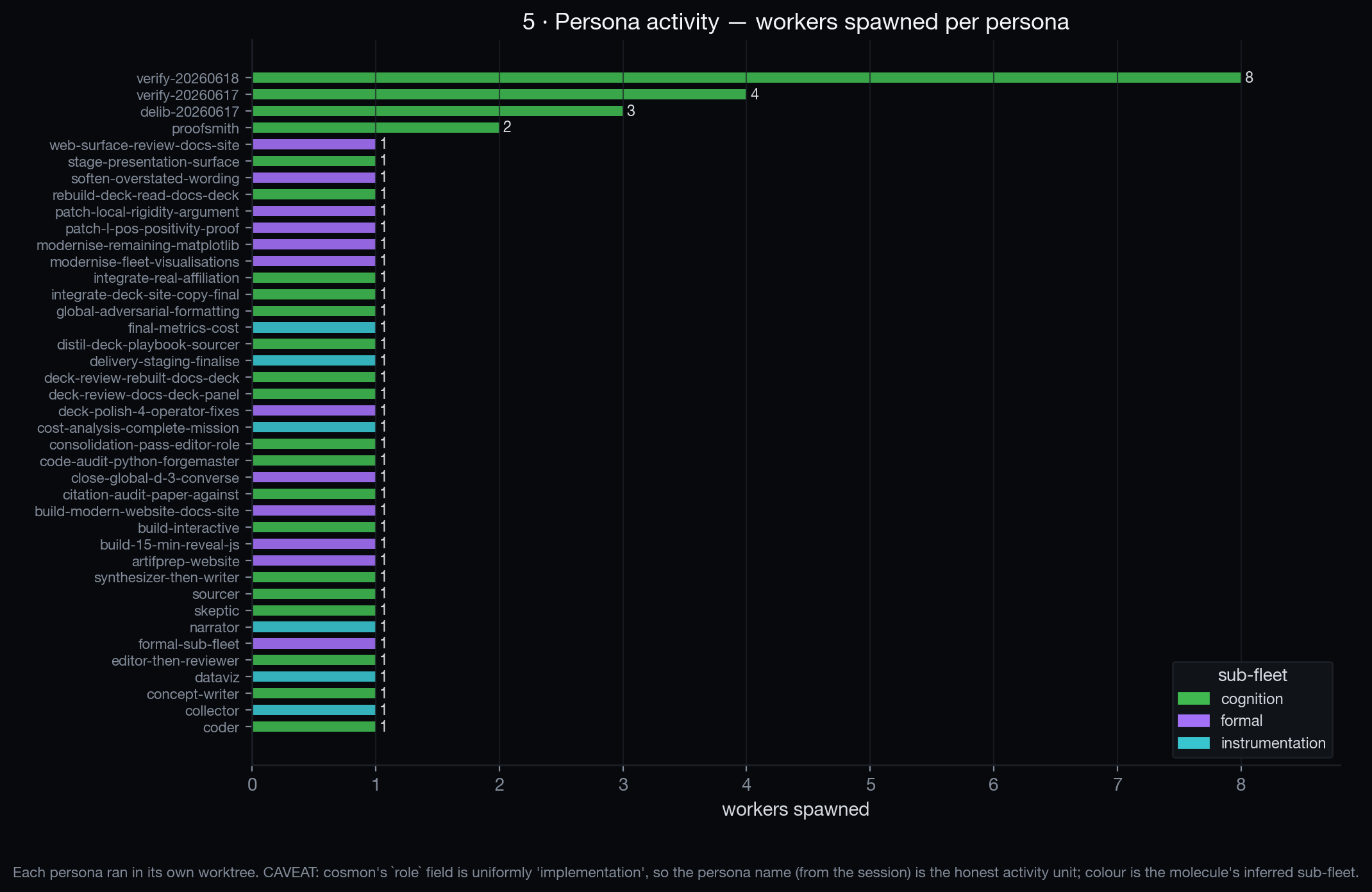
The whole ethic in miniature: the fleet proved what it could prove to the hilt,
marked the rest with a steady finger instead of a flourish — then went back and
closed the hard one honestly, demoting the nine-thousand-pair numerical
sweep from evidence to a sanity check the moment a real proof existed.
The trust isn't in the agents — it's in the gate the agents couldn't argue with.
The full narrative is in
report/report.md.
§6 · Reproduce / verify
Everything on this page regenerates from the repo. The status strip and the terminal verdict above are produced mechanically by the build script from real command output — not hand-typed.
# clone and check the proof
git clone https://github.com/noogram-labs/flow-matching-gaussians
cd flow-matching-gaussians/lean
lake build                              # exit 0 = the anchor theorem is accepted
bash FMG/Adversarial/check-adversarial.sh   # 9/9 — author ≠ scorer

# regenerate the notebooks, the Lean HTML, and the paper copy
bash docs/site/artifacts/build.sh

# regenerate the seven report figures from the fleet's own event log
python3 report/collect.py               # .cosmon/state → report/data/*.csv (read-only)
python3 report/render.py                # report/data/*.csv → report/figures/*.png
python3 report/fleet_viz.py             # events.jsonl → figures/fleet_*.svg + fleet.html

# rebuild this website (refreshes the status strip from live commands)
bash docs/site/build.sh| Provenance | Value |
|---|---|
| Built from commit | dd226f2 (dd226f258a9db92be28e121349c1160bb3fab774) |
| Build timestamp | 2026-06-18 (mechanically stamped by docs/site/build.sh) |
| Anchor theorem | FMG.flowMap_isHermitian_pushforward_eq_otMap_of_commute |
| Lean source blob | 760ec9b3afb37978b6acb840a260cff0ae283ea6 — matches kernel-provenance.log |
| Lean toolchain | leanprover/lean4:v4.29.0 · Mathlib v4.29.0 |
§7 · References — the closed citable set
The only set the writers may cite. Every identifier was verified
against the authoritative record (arXiv abstract or registered DOI) —
fabricating a DOI is a blocker fault, and none below are fabricated. Tier and
relevance live in
source-ledger.md;
the machine-readable set is
references.bib.
- 1Building Normalizing Flows with Stochastic Interpolants ↗
- 2Stochastic Interpolants: A Unifying Framework for Flows and Diffusions ↗
- 3Flow Matching for Generative Modeling ↗
- 4Flow Straight and Fast: Learning to Generate and Transfer Data with Rectified Flow ↗
- 5Score-Based Generative Modeling through Stochastic Differential Equations ↗
- 6Computational Optimal Transport: With Applications to Data Science ↗
- 7A Convexity Principle for Interacting Gases ↗
- 8On the Bures–Wasserstein distance between positive definite matrices ↗
- 9Wasserstein geometry of Gaussian measures ↗
- 10Geometry of Matrix Decompositions Seen Through Optimal Transport and Information Geometry ↗
- 11Polar Factorization and Monotone Rearrangement of Vector-Valued Functions ↗
- 12The distance between two random vectors with given dispersion matrices ↗
- 13Flow Matching Guide and Code ↗